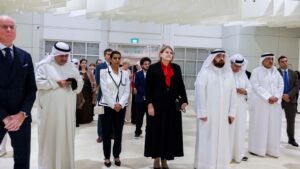

On 12 February 2026, the photo exhibition “Brave to be Strong” opened in the State of Kuwait with its author, photographer Eduard Kryzhanivskyi, in attendance. Kuwait became the first Arab country to host the exhibition, according to statements by the Ministry of Foreign Affairs of Ukraine and the press service of the Delegation of the European Union to the State of Kuwait.
The event, marking the fourth anniversary of Russia’s full-scale invasion of Ukraine, was organised jointly by the Embassy of Ukraine in Kuwait and the Delegation of the European Union to the State of Kuwait at the EU residence, under the title “Brave to be Strong: Voices of Resilience”.
The exhibition had previously been shown in Pakistan, Poland, the Czech Republic, Israel, Moldova and Türkiye.

The exhibition features photographs by Eduard Kryzhanivskyi, the official photographer of Ukraine’s Ministry of Foreign Affairs, documenting the reality of the war. The images capture pain and loss, forced displacement and destruction, as well as the courage, resistance and endurance of Ukrainian soldiers and civilians.
Alongside the photographs, visitors were shown posters by Ukrainian artists created during the full-scale war. The works explore loss and displacement, everyday life under threat, civic resilience, solidarity and the strength of Ukrainian society. Each poster was accompanied by a short text in which the artists recall the first days of the full-scale invasion.
The event was attended by representatives of Kuwait’s Ministry of Foreign Affairs, foreign diplomats, and representatives of international organisations, charitable foundations and leading media.
 EU Ambassador to Kuwait Anne Koistinen said in her remarks that the joint exhibition of the Ukrainian Embassy and the EU Delegation in Kuwait tells a human story of courage, resilience and the unbreakable spirit of the Ukrainian people. The poster display, she said, brings together works by Ukrainian artists created during Russia’s full-scale invasion of Ukraine that reflect the realities of war: loss, forced displacement, life under constant threat, solidarity and the strength of society.
She also stressed that energy has become a new front line. The European Union is responding with the largest winter aid package in its history, covering emergency equipment, funding and energy supplies. According to her, the energy fund has exceeded 1.6 billion euros, while total EU assistance to Ukraine, including financial support and aid to Ukrainian refugees, stands at 193.3 billion euros. The ambassador added that the Ukrainian people are an inspiration to Europeans and can count on the EU’s support.

Ukraine’s Ambassador to Kuwait Maksym Subkh stressed that the event was taking place on the eve of a tragic date: four years since the start of Russia’s full-scale invasion of Ukraine, which has become one of the largest humanitarian crises of our time. Behind the words about resilience, he said, lies immense human suffering, which is why international solidarity is essential. He noted that humanitarian aid directed at supporting the energy sector during severe frosts directly saves lives and eases the suffering of civilians. The ambassador also said that Ukraine’s Foreign Minister Andrii Sybiha had called on international partners to support Ukrainians over the winter as part of the #WarmthForUkraine campaign, aimed at providing heat and electricity to those who need it.
The event also featured works by Ukrainian composers Mykola Lysenko and Yuriy Shchurovsky.
The organisers said the exhibition aims to honour the resilience of Ukrainian society and draw attention to the humanitarian consequences of Russia’s war against Ukraine.
Photo: Ministry of Foreign Affairs of Ukraine