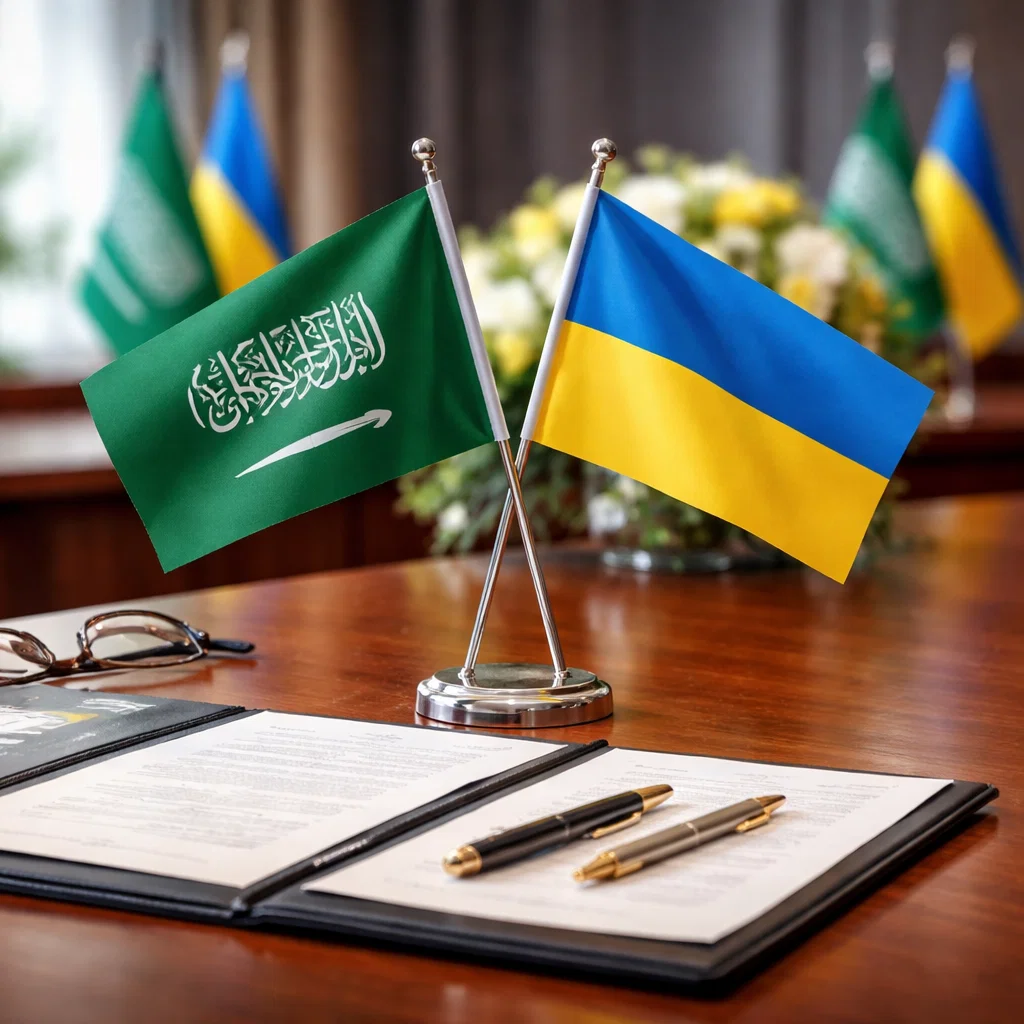
[vc_row][vc_column][vc_column_text css=””]Relations between Ukraine and Saudi Arabia gained new momentum in 2025, reflecting shifts in the global geopolitical architecture and both countries’ desire to diversify their foreign policy ties. Despite the geographic distance and differences in political systems, Kyiv and Riyadh are showing growing mutual interest, grounded in pragmatic economic calculations and shared security challenges.
The political foundations of bilateral relations
Diplomatic relations between Ukraine and Saudi Arabia, established in April 1993, remained largely formal for a long time. Russia’s full-scale aggression against Ukraine, however, became a catalyst for rethinking these ties. Saudi Arabia, with its own experience of confronting regional threats and a desire to strengthen its standing on the international stage, sees the Ukrainian track as part of a broader strategy of global positioning.
In 2025, political dialogue between the two states continues to develop primarily through multilateral platforms. Saudi Arabia maintains a carefully balanced position on Russia’s war against Ukraine, avoiding direct confrontation with Moscow in light of its economic interests within OPEC+, while showing readiness to provide humanitarian support to Ukraine and to take part in diplomatic efforts to find ways to end the war.
Notably, in 2023–2025 Riyadh became a venue for international diplomatic contacts related to settling Russia’s war against Ukraine, including with the participation of Ukraine and its key partners. This activity is consistent with the Vision 2030 strategy, under which the kingdom seeks to strengthen its international role beyond traditional oil diplomacy.
Economic prospects: from grain to infrastructure
The economic dimension of Ukraine–Saudi relations has traditionally centred on trade in agricultural products. Despite the challenges of war, Ukraine remains an important potential food supplier for the Middle East, while Saudi Arabia, which imports more than 80% of its food (as of 2024), is interested in reliable suppliers of grain, vegetable oil and other agricultural products.
Before the full-scale war, bilateral trade between Ukraine and Saudi Arabia exceeded USD 800 million (2020). In 2022–2024, trade turnover fell and was estimated at a few hundred million US dollars due to hostilities and logistical constraints, pointing to significant untapped potential for economic cooperation.
In 2025, Saudi entities have shown interest in taking part in the reconstruction of Ukrainian infrastructure, particularly in the energy sector and logistics. Given Saudi Arabia’s experience in delivering large-scale infrastructure projects such as NEOM, the Ukrainian market may be viewed as a promising destination for future investment, especially in renewable energy and green technologies.
Cooperation in halal products is another promising area. Ukraine has significant potential to produce meat and dairy products in line with Islamic standards, which could open access not only to the Saudi market but to the wider Gulf market as well.
Visa policy and people-to-people contacts
Visa requirements between Ukraine and Saudi Arabia remain in place for both sides in 2025. At the same time, Ukrainian citizens are among those eligible to apply for a Saudi electronic tourist visa through the official government portal.
For Ukrainians working in Saudi Arabia, particularly in construction, healthcare and education, there is a work visa system, with the application process depending on an invitation from the employer. The scale of labour migration from Ukraine to Saudi Arabia, however, remains limited compared with other destinations.
Cultural dialogue: challenges and opportunities
Cultural exchanges between Ukraine and Saudi Arabia are still at an early stage in 2025. Significant differences in cultural traditions, religious practices and historical experience create both challenges and opportunities for mutual enrichment.
Education is a promising area of cooperation. Saudi Arabia, which is investing heavily in higher education and research, may be interested in working with Ukrainian universities, especially in engineering, information technology and agriculture. Ukrainian students, in turn, could benefit from scholarship programmes at Saudi universities, which attract talented young people from around the world as part of the kingdom’s international strategy.
The religious dimension also plays a role in bilateral relations. For Ukraine’s Muslim community, which by various estimates numbers hundreds of thousands of people, Saudi Arabia remains an important spiritual centre. Organising pilgrimages to the holy cities of Mecca and Medina for Ukrainian Muslims is one of the practical aspects of humanitarian cooperation between the two countries.
Energy and security: indirect points of intersection
Although Ukraine and Saudi Arabia are neither direct competitors nor partners in the energy sector, global energy trends create indirect points where their interests intersect. Saudi Arabia’s policy within OPEC+ directly affects world oil prices, with consequences for the Ukrainian economy as an energy importer.
In terms of security, the two countries face different but partly comparable challenges: Ukraine is resisting direct military aggression, while Saudi Arabia has experience countering regional threats, including attacks by Yemen’s Houthi groups. This experience could form the basis for knowledge-sharing in civil protection, critical infrastructure protection and humanitarian response.
The multilateral dimension of cooperation
International organisations and multilateral formats remain an important channel of engagement between Ukraine and Saudi Arabia in 2025. Both countries are UN members and take part in the work of its specialised agencies. As a G20 member, Saudi Arabia could potentially help advance Ukrainian initiatives, particularly on global food security and support for post-war reconstruction.
Saudi Arabia’s potential role in financing Ukraine’s reconstruction deserves separate mention. With substantial financial reserves and experience in delivering large-scale infrastructure projects through the Public Investment Fund (PIF), the kingdom could be considered one of the possible partners in the medium term.
Obstacles to deeper cooperation
Despite the potential for developing relations, a number of factors hold back deeper Ukrainian–Saudi cooperation. These include Riyadh’s caution about fully backing Ukraine during the war, limited diplomatic presence and the absence of direct transport links, as well as the need to take cultural and religious specificities into account when building long-term contacts.
Conclusions
Relations between Ukraine and Saudi Arabia in 2025 are characterised by restrained momentum and a gradual expansion of practical engagement. Although the two countries are not traditional partners, the changed geopolitical landscape is creating new opportunities for cooperation.
For Ukraine, Saudi Arabia is a potential investor, an export market and an influential player that can help advance Ukrainian interests on the international stage. For Saudi Arabia, Ukraine is of interest as an element of its broader global positioning strategy in line with the goals of Vision 2030.
Realising this potential will require political will, strategic planning and a shift from declarations to practical steps on both sides.[/vc_column_text][/vc_column][/vc_row]