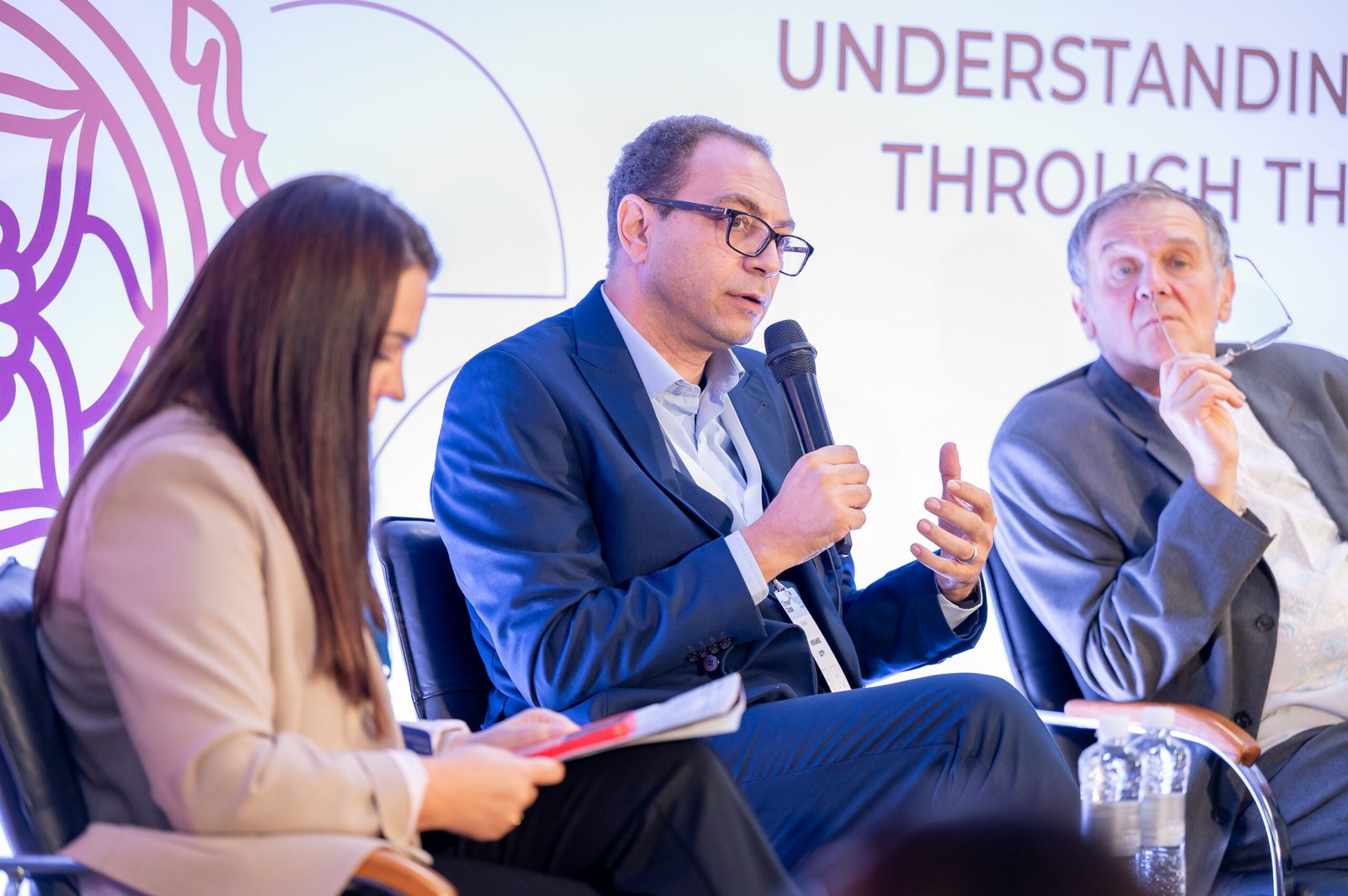
Mohamed Lotfy once believed that Egypt lagged around 25 years behind democratic countries, even behind Latin America. Now he is convinced that Egypt is ahead, but in authoritarianism, and that the world is gradually sliding down to its level. The executive director of the Egyptian Commission for Rights and Freedoms made the point in Kyiv on 19 October at the international conference Crimea Global.
He held up Ukraine as the opposite example: a country that, in his view, has managed to keep its democracy despite the war.
Egypt has been there already
Lotfy spoke on a panel about how democracy can survive in the age of artificial intelligence and great powers. Moderator Tetiana Pechonchyk, head of the board of the ZMINA Human Rights Centre, asked him what Europe could learn from Egypt’s experience and what the first signs are that a country is losing its democracy.
Torture in Egypt is systematic, Lotfy said. In 2018, by his account, the country ranked fourth in the world for executions, after China, Iran and Saudi Arabia. The world is now sliding down to Egypt’s level while Egypt cannot catch up with democratic countries, he said, and he wants his voice to be heard as a warning to the rest of the world.
Dictatorship is not Egypt’s fate, he stressed. In the 1950s and 1960s, according to Lotfy, the country had freedom of speech and freedom of assembly. As an example of what is happening to democracy elsewhere, he pointed to the United States: a country where, as he put it, democracy is built into its genes, but where core institutions are now being eroded and society is becoming polarised, even fascist.
Egypt has already been through this and is now ahead of the world, Lotfy said, but its future looks grim. Democracy, he believes, is not granted by default and has to be worked on every day, by confronting the fanaticism, xenophobia and racism on which despots build their power.
Why it did not work in Egypt
Lotfy recalled that in 2014 he had many discussions with Ukrainian colleagues and drew parallels between the two countries. Egypt failed, he said, while Ukraine succeeded. Ukraine, in his words, has a democratic government, and democratic forces are holding back Russia’s aggression.
Lotfy also blames outside influence for the defeat of Egyptian democracy. Regional players, he said, did not think Egyptians deserved democracy. Democratic forces received no support from France or Britain. Saudi Arabia, the UAE, the European Union and even the United States, in Lotfy’s view, preferred a military dictatorship that would serve their interests. Egypt now needs strong partnerships with democratic allies, he believes.
Pechonchyk recalled that she herself had been in Tahrir Square in 2011. Ukrainians, she noted, went through the Orange Revolution and the Revolution of Dignity and remained a democratic country despite all the difficulties.
Not such great powers after all
When the audience asked whether the world is becoming a world of great powers, Lotfy questioned the term itself. The United States, he said, started a war against Iran, cannot end it and has in effect lost it. Russia started a war against Ukraine and is losing it. France and Britain feel vulnerable to Russia and say they need a decade to prepare to defend their territory.
That is why, in Lotfy’s view, great powers can be challenged, and the world is going through a transition in which new forces are emerging. He said he hopes Ukraine will be one of those new forces and will carry democracy with it. Like many people, he admitted, he has lost faith in the great powers and in the values they claim to defend, including human rights and equality. But those values must still be defended, he stressed, without repeating others’ mistakes.
AI: it is not the weapon, but the person who pulls the trigger
Lotfy believes artificial intelligence should not be feared too much. New technologies have to be adopted and adapted to people’s needs; otherwise dictators will be the first to use them for surveillance and repression.
He gave an example from his own experience. A doctor offered him an AI-based medical device and reassured him that it would work at least no worse than he would himself. Humanity, Lotfy noted, has already gone through genocides and atomic bombings, and people have killed one another over religion. Perhaps AI can help us become better, he said, and at the very least it will not be worse than us.
At the end of the discussion Lotfy returned to the idea. Fire can kill, but it can also be used to cook, he said. The genocide in Rwanda and the massacre in Srebrenica happened without social media or artificial intelligence. It is not the weapon that matters, he said, but the person who holds it and pulls the trigger. Societies should focus on their own values, because inventions will keep coming. The problems, Lotfy concluded, are our responsibility.
Background
Mohamed Lotfy and Ahmed Abdallah founded the Egyptian Commission for Rights and Freedoms (ECRF) after the 2013 military coup. The organisation documents enforced disappearances, arbitrary arrests and torture, and provides legal aid to victims. Over five years, its Stop Enforced Disappearances campaign recorded 2,723 cases. In 2020, ECRF received Norway’s Rafto Prize, according to the Rafto Foundation. Lotfy is also a board member of the World Organisation Against Torture.
According to Amnesty International, Egypt ranked third in the world for executions in 2020, with 107, after China and Iran, having tripled the number compared with 2019 (Al Jazeera).
In Freedom House’s Freedom in the World 2026 report, Egypt is rated Not Free, with a score of 18 out of 100. President Abdel Fattah al-Sisi, who came to power after the 2013 coup, rules in an authoritarian manner, and there is almost no real opposition, Freedom House notes.
About the conference
The fourth international conference “Crimea Global. Understanding Ukraine through the South” was held in Kyiv on 19 October 2026 under the slogan “Navigating a World of Great Powers”. It was organised by the Mission of the President of Ukraine in the Autonomous Republic of Crimea / Office of the Crimea Platform, the ZMINA Human Rights Centre and the Media Initiative for Human Rights. Partners were Ukraine’s Ministry of Foreign Affairs, the Ukrainian Institute and the Centre for Transatlantic Dialogue.
The panel “Big Brother is Back? How Can Democracy Survive in Times of AI and Great Powers” was moderated by Tetiana Pechonchyk, head of the board of the ZMINA Human Rights Centre and co-organiser of the conference. Remarks are reported from the Ukrainian simultaneous interpretation broadcast during the conference. The full recording is available on YouTube.