
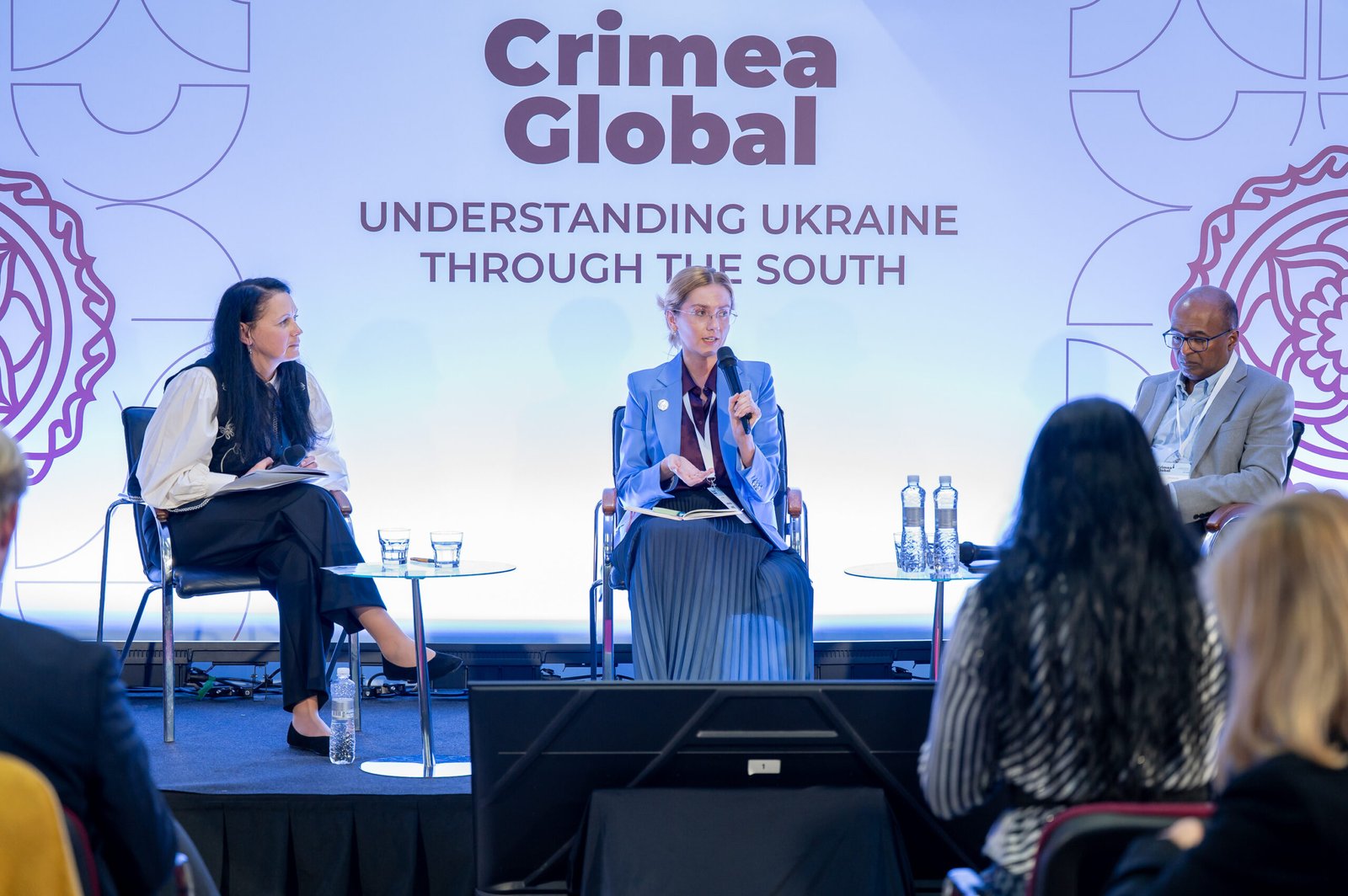
Syria now has commissions on transitional justice and on missing persons, but it has yet to decide who counts as a victim and from which year crimes should be counted. Syrian economist and civil society activist Assaad Al Achi described the dilemma at the international conference Crimea Global in Kyiv on 19 October.
About the main defendant he has no doubts. A court in Damascus has sentenced Bashar al-Assad to death in absentia, but Russia, where Assad has lived since fleeing, will not hand him over. Putin, Al Achi said, is as much a criminal as Assad.
Two commissions and three laws
Al Achi, co-coordinator of the Syria Resource Group at the Institute for Integrated Transitions, joined the transitional justice panel online. Moderator Tetiana Katrychenko asked how Syrian civil society had shaped the new institutions and whether the authorities were involving it.
The commission on missing persons and the commission on transitional justice were set up within a few months of the regime’s fall, Al Achi said. They have worked at different speeds, and the missing persons commission has been more visible. Civil society, he said, is actively involved: the commissions include specialists and heads of NGOs who worked on human rights under Assad, and consultations are under way in the provinces.
Three laws are now on the agenda: on missing persons, on transitional justice and on political isolation, which Al Achi described as a tool of restorative justice. The parliament, selected back in October 2025, only began work in July 2026, so the legislative process is just starting. Al Achi hopes the laws will pass quickly. He called the drafts on political isolation and on missing persons decent, if not ideal.
Who is a victim, and from which year
The transitional justice bill raises the most questions for him. The first is who counts as a victim. Only those who suffered at the hands of the former regime, or anyone harmed during 14 years of conflict, regardless of who the perpetrator was?
We should not forget what happened in Syria, Al Achi said. The conflict did not end in a political settlement: one armed group won. The definition of a victim in the current draft is very narrow, he said, and that will directly affect who can receive reparations.
The second question is the time frame. Will the law cover only the period from the 2011 uprising to the regime’s fall in 2024? The whole rule of the Assads, father and son, going back to 1970? Or even the entire period of Baath Party rule?
The third, and most painful, question is what to do about crimes committed after 2024. Al Achi pointed to two major episodes of mass killings for which government forces have been blamed: on the coast in March 2025 and in the south of the country in July of the same year. Who will be held responsible for them, and should they be part of transitional justice?
The current government, he said, does not want to talk about this at all. For the authorities, transitional justice ended with the fall of the regime, and everything that happened afterwards should go through the ordinary law enforcement system under the existing criminal code.
Contacts with the diaspora are also only beginning. The commissions have held several seminars with Syrian refugees in Germany, Lebanon and Egypt, and NGOs are signing memoranda with them on information sharing and training. It is all just starting, Al Achi said.
A verdict in Damascus, Assad in Moscow
Katrychenko asked how the death sentence against Bashar al-Assad fits into transitional justice. Abolishing the death penalty in Syria will be very difficult, Al Achi replied, but a moratorium is now being discussed. Assad was not the only one sentenced to death: so were his brother and other defendants tried in absentia. Activists are urging the president to impose a moratorium on carrying out these sentences, he said, but there has been no final answer yet.
There is a deeper, legal problem too. Syria’s current criminal and penitentiary codes do not recognise crimes against humanity or war crimes, so lawyers have to argue that international law takes precedence over national codes.
About Assad himself, Al Achi has no illusions. He does not believe Russia will hand him over, he said, because Putin is a criminal just like Assad, and criminals like to support one another. Even if Syria adopts a moratorium, he does not believe Putin will act in line with human rights. But the trial took place and the verdict was delivered, he stressed.
What worked before the regime fell
Syrians did not wait for Assad’s fall to start working on justice, Al Achi said. It all began with documentation, which is why he admires the documentation work of Ukrainian colleagues.
With the support of victims’ families, two UN mechanisms were created before the regime fell: the International, Impartial and Independent Mechanism for Syria and the Independent Institution on Missing Persons in the Syrian Arab Republic. Back then they had no access to the country. They now do, but implementation is running into difficulties, Al Achi said.
Another tool that worked was international litigation. Together with Canada and the Netherlands, Syrian activists brought a case against Syria at the International Court of Justice under the Convention against Torture over what happened in Assad’s prisons. These proceedings were more symbolic than a real accountability mechanism, Al Achi admitted, but they helped increase diplomatic pressure.
What Ukraine can take from this
After the Syrian experience, the moderator turned to Kateryna Busol, head of the Ukraine programme at the International Center for Transitional Justice (ICTJ) and associate professor of law at the Kyiv-Mohyla Academy. Busol outlined three areas in which, in her view, Ukraine is charting its own course.
The first is early accountability. Like Colombia, Ukraine has launched justice mechanisms without waiting for the war to end. Human rights defenders were active from the time part of Donbas was occupied, and since the full-scale invasion, organisations led by survivors themselves have emerged. Survivors of conflict-related sexual violence speak publicly, and they want not only punishment for perpetrators but also reparations. Around 2,000 survivors have already received one-off payments, and survivors themselves took part in designing that mechanism, Busol said.
The second is transitional justice during a prolonged occupation. Ukraine insists that crimes must be addressed comprehensively now, not only after territories are liberated.
The third concerns international law. Crimes committed by the leaders of an aggressor state must not go unpunished, and international law should provide not only reparations for victims but also state responsibility, Busol said.
At the end of the discussion she added that the international community should invest in civil society on the ground. In Ukraine, survivors’ associations already travel to de-occupied territories to explain to people how to seek accountability for crimes.
Background
Bashar al-Assad fled to Moscow on 8 December 2024, when his regime fell. Russia granted him asylum, the BBC reported, and has so far refused to hand him over despite Damascus’s demands.
On 11 August 2026, Damascus’s Fourth Criminal Court sentenced Bashar al-Assad and his brother Maher al-Assad, both in Russia, to death in absentia. Atef Najib, former head of political security in Daraa province, who was arrested in January 2025, received the same sentence, Al Jazeera reported.
The national commissions on transitional justice and on missing persons were established by decrees of interim President Ahmed al-Sharaa in May 2025 (Al-Monitor). Human Rights Watch criticised the transitional justice commission’s mandate at the time for focusing only on the former regime’s crimes. Syria’s new parliament held its first session on 12 July 2026 (The New Arab).
Around 1,400 people, mostly Alawites, were killed in violence on Syria’s coast in March 2025. The UN Commission of Inquiry on Syria found that war crimes were likely committed both by interim government forces and by fighters loyal to the former authorities (Reuters, via Al-Monitor). Nearly 2,000 people were killed in violence in Sweida province in July 2025, according to the Syrian Observatory for Human Rights, including 765 Druze civilians who, according to monitors, were executed by government forces (AFP, via L’Orient-Le Jour).
Canada and the Netherlands filed their case against Syria under the Convention against Torture at the International Court of Justice in June 2023. In November 2023, the court ordered Syria to take provisional measures to prevent torture (International Court of Justice).
About the conference
The fourth international conference “Crimea Global. Understanding Ukraine through the South” was held in Kyiv on 19 October 2026 under the slogan “Navigating a World of Great Powers”. It was organised by the Mission of the President of Ukraine in the Autonomous Republic of Crimea / Office of the Crimea Platform, the ZMINA Human Rights Centre and the Media Initiative for Human Rights. Partners were Ukraine’s Ministry of Foreign Affairs, the Ukrainian Institute and the Centre for Transatlantic Dialogue.
The panel “Transitional Justice: What We Can Learn from Recent Examples” was moderated by Tetiana Katrychenko, head of the Media Initiative for Human Rights and co-organiser of the conference. Assaad Al Achi took part online. Remarks are reported from the Ukrainian simultaneous interpretation broadcast during the conference. The full recording is available on YouTube.
Read also: Hormuz and the Black Sea: why the security of Ukraine and the Gulf has become a shared concern