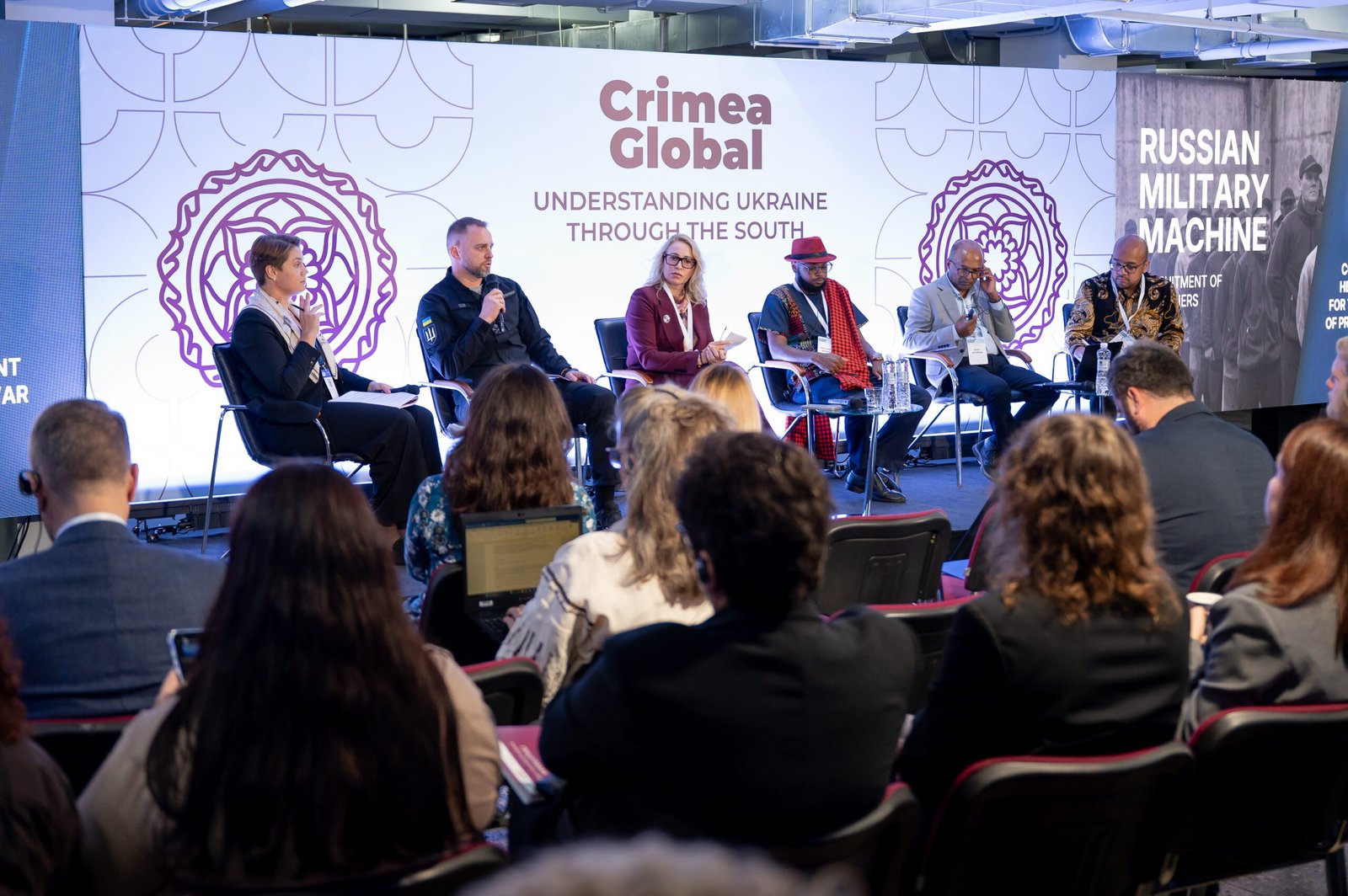
Russian recruiters are targeting labour migrants who have already worked in the Gulf states. Kenyan journalist Paul King’ori Wangechi described the pattern, using Kenya as an example, at the fourth international conference “Crimea Global. Understanding Ukraine through the South” in Kyiv on 19 October.
At the same panel, Ukraine’s Coordination Headquarters for the Treatment of Prisoners of War released new figures on the recruitment of foreigners: Russia has signed military contracts with nearly 46,000 foreign nationals from 151 countries. Recruiters are increasingly focusing on Africa, and a Russia–Africa summit is due to take place in Moscow on 28–29 October.
Kenya: recruiters go after those who worked in the Gulf
Wangechi, a producer and host at the Kenyan outlet Tuko, described three groups that recruiters target.
The first are people who have already worked in the Gulf. They hold passports, have experience of working abroad and are open to such offers, he said. Recruiters offer them familiar jobs as security guards, cooks, domestic workers and drivers, but with better pay.
The second are employees of private security firms. Some of them, Wangechi said, carry trauma and understand they will not come back. The third are people disappointed by the government’s promises of jobs.
In Russia, recruits are handed contracts in Russian, a language they do not understand, Wangechi said. A bank account is opened jointly in the name of the recruit and a Russian agent, and around $7,000 is paid into it. Once the man is sent to the front, the agent takes half and passes the other half to an agent in Kenya.
In effect, Wangechi said, a Kenyan fighter’s life is worth $7,000, and the war combines military operations with human trafficking.
The Kenyan government reported 352 confirmed cases to parliament, he said, while journalists and families count 841 Kenyans who are missing, killed or wounded. Most of those still fighting on Russia’s side would return home at once if they had money and documents, he added.
After media reports, protests by families and debate in parliament, recruitment of Kenyans has fallen by around 80%, by his estimate. Human stories work best, he said, such as that of a mother who can no longer reach her son. His message to Kenyans is simple: do not go to Russia.
Some still go voluntarily. Those he spoke to, Wangechi said, described it as a one-way ticket.
Nearly 18,000 more in a year
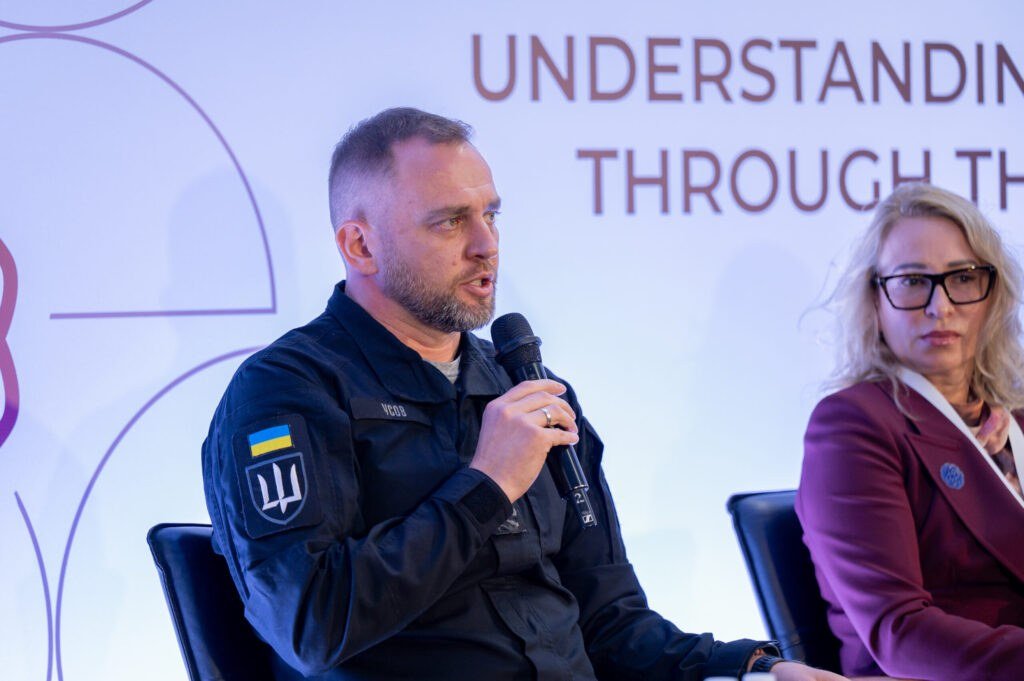
At last year’s conference, the Coordination Headquarters spoke of 28,000 foreigners from 138 countries. The figure now stands at nearly 46,000 from 151 of the 193 UN member states, said Brigadier General Dmytro Usov, the headquarters’ secretary.
“Today we have a figure of nearly 46,000 foreigners who have signed contracts with the Ministry of Defence of the Russian Federation. And that is already 151 countries,” Usov said.
The headquarters holds full personal data on each of them, including position, rank, ID tag, contract and date of signing, he said. For another 668 people, the year of signing is still being established. The data are current as of 1 or 12 October 2026.
In 2022 the headquarters recorded only 94 contracts, and the number has grown every year since. Russia’s defence ministry plans to sign up 18,500 foreigners in 2026 and has already signed 16,168 contracts, Usov said. At the current pace, he expects Russia to meet or exceed the target.
Recruitment has been reduced in some countries and halted entirely in others, he said, crediting Ukraine’s foreign ministry, the agencies dealing with prisoners of war and agreements with governments. The headquarters promised to publish updated figures on its website.
When a government agrees with Moscow to end recruitment, Usov said, a different signal appears on the battlefield: its citizens are not released from their contracts but sent into assaults “so that there are fewer questions later”.
Citizens of 59 countries are held as prisoners of war in Ukraine. Most come from Uzbekistan, Tajikistan, Belarus, Colombia, Kazakhstan, Azerbaijan and Kyrgyzstan.
What the prisoners say
The headquarters surveyed foreign prisoners of war, and Usov presented the results for the first time at the conference.
About 49% knew they were going to fight in Ukraine. “Most of those in our captivity, and those who signed contracts, knew where they were going,” Usov said. Nearly 15% were unsure, and some were not told where they were being sent.
Nearly 47% signed up to obtain Russian citizenship, which, according to Usov, cannot be obtained in Russia without a defence ministry contract. Some 48.8% were taken prisoner wounded rather than surrendering voluntarily.
“What surprised me was the figure: nearly 79% want to return to Russia. They do not want to return to their own countries,” Usov said. The prisoners say they want to claim the money and benefits they were promised. Another 41% signed through military enlistment offices and recruitment points, which Usov called evidence of a systematic effort by Russia’s defence ministry and security services.
Russia recruits foreigners because of its heavy losses, Usov said. This eases social and budget pressure at home and spares the state from dealing with the families of the dead and captured.
Focus on Africa and Latin America
In 2026, Russian recruiters have concentrated on Africa and Latin America, Usov said. According to the headquarters, Africa’s share rose from 1% in 2023 to 16.5%, and Latin America’s from 2.5% to 15%.
Recruiters exploit “poverty, weak state policy and very little information about the war”, Usov said. He urged the countries concerned to talk about the war and about their citizens dying on Ukrainian soil. Ukraine is open to journalists from any country and shows them the camps where foreign prisoners are held, he added.
Panel moderator Maria Tomak noted that recruitment in Africa reaches many countries, including Cameroon, Botswana and Zimbabwe, adding that she was not even referring to the north of the continent.
Ukraine’s foreign ministry: “a whole industry”
Liubov Abravitova, director of the Africa and Regional African Organisations directorate-general at Ukraine’s foreign ministry, called recruitment a global phenomenon that Moscow pursues actively in Africa. Russia exploits poverty and vulnerability, she said, and in this way avoids further mobilisation at home.
The total number of foreigners in Russia’s army now exceeds the size of many European armies, Abravitova said. Recruits themselves are told a different story: that they are going to fight the West and Europe, not Ukrainians. She also cited Alabuga in Tatarstan, where young women are drawn in to produce drones.
Recruitment has become commercial and fragmented, a whole industry in which some businesses operate as franchises, she said. She counted 289 platforms and channels that generate content with artificial intelligence; when one is shut down, another appears.
Talks with governments do not stop recruiters on the ground, Abravitova said. Border controls in Africa are weak: in South Africa, for example, migrants from Zimbabwe are being recruited. Many African countries ban fighting for a foreign state, so those who return risk prison.
Ukraine has embassies in only 18 of Africa’s 54 countries, so the ministry relies on the media, civil society and trusted voices, including a request to Caritas to spread information through churches. Ukraine expects a more active role from the African Union, she said.
At the end of the discussion, Abravitova recalled the Russia–Africa summit on 28–29 October, noting that such forums often produce framework agreements and that Kenya plans a labour agreement with Russia. This is not only a matter for diplomats, she told participants, but for them too.
Sri Lanka and Cuba: real numbers may be higher
According to the headquarters, Russia has recruited 283 Indonesians and 750 Sri Lankans. Sri Lankan investigative journalist Saroj Pathirana, a fellow of OCCRP, puts the number of his compatriots far higher, at 2,000 to 3,000, saying recruits receive Russian citizenship and drop out of the statistics. Erich de la Fuente, a professor at Florida International University, estimated the number of Cubans in the Russian army at around 20,000.
Where to find information, including in Arabic
The Coordination Headquarters represents Ukraine’s Defence Intelligence (HUR), and its figures come from intelligence or from open sources that are then verified, Usov said. Data the headquarters published earlier were later confirmed by the countries concerned.
Usov named three projects Ukraine uses to reach foreigners and their families. “I Want to Live” has recorded more than a hundred videos with foreign prisoners. The “I Want to Find” chatbots help relatives in many countries search for those who went to Russia. StopRussianRecruiters.org, run jointly by the headquarters and the foreign ministry, explains recruitment schemes. These resources are available in English, French, Spanish and Arabic, Usov said.
He also warned of risks for countries to which recruits return: all foreigners under contract, he said, pass through Russia’s military intelligence (GRU) or the FSB. “The return of each such citizen carries certain risks that these citizens may cooperate with such structures on the territory of those countries,” Usov said.
Background
Compiled by Qahwa.Media from earlier reporting.
In April 2026, presenting a report on foreign fighters in Russia’s army, Usov said recruitment had been significantly reduced in countries including Egypt and Syria, LIGA.net reported. He also said foreigners were working at Russian defence plants, most of them citizens of India, Nepal and Egypt.
The Coordination Headquarters and Ukraine’s foreign ministry launched StopRussianRecruiters.org on 25 May 2026. At the time, the project cited more than 28,000 foreigners under contract and at least 5,149 killed, Kyiv Post reported.
The third Russia–Africa summit is scheduled for 28–29 October in Moscow. Seventeen African leaders have confirmed attendance, according to the French outlet Africa Intelligence, as cited by Al Jazeera. Al Jazeera also cited Russia-Africa Monitor as saying that the recruitment of Africans to fight in the war is causing growing anger as the numbers of dead, wounded and missing rise.
Egyptian President Abdel Fattah al-Sisi co-chaired the first such summit with Putin in Sochi in 2019, according to the Egyptian presidency.
About the conference
The fourth international conference “Crimea Global. Understanding Ukraine through the South” was held in Kyiv on 19 October 2026 under the slogan “Navigating a World of Great Powers”. It was organised by the Mission of the President of Ukraine in the Autonomous Republic of Crimea / Office of the Crimea Platform, the ZMINA Human Rights Centre and the Media Initiative for Human Rights. Partners were Ukraine’s Ministry of Foreign Affairs, the Ukrainian Institute and the Centre for Transatlantic Dialogue.
The panel “Countering the Predator: How to Stop Russia’s Recruitment of Foreigners” was moderated by Maria Tomak, associate researcher at Truth Hounds and co-organiser of the conference.
Figures are those of the Coordination Headquarters as presented at the conference. Remarks by speakers are reported from the conference broadcast; quotations from Ukrainian-speaking participants were translated by Qahwa.Media. The full recording is available on YouTube.